
ECRITURE - SCIENCE-FICTION - LANGUES - MUSIQUE - BLU-RAY - LIENS
Raymy 32 Handbook - Chapter 03 : To Repeat And Itemize
French Version - Table Of Contents - Bibliothèque dédiée
par David Sicé
What follows will give you the basis of the Raymy language. The Raymy langage is a constructed language in which words are defined by the signes that composed them – verbally, the syllables.
***
***01***
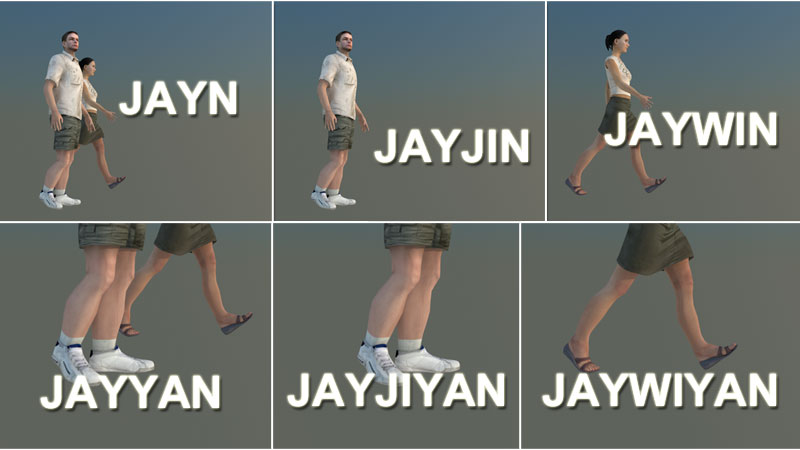
AY-Roots can contain extra syllables from the AY vowel until the final N. In this case, the word evokes something more accurate than the racine without the extra syllables.
JAYN : An individual - individuals.
JAYJIN : A man - men.
JAYWIN : A woman - women.
JAY YAN : A leg - legs.
JAYYAJIN or JAYJIYAN : A man's leg - men's legs.
JAYYAWIN or JAYWIYAN : A woman's leg - women's legs.
***

***02***
The same applies to identical OU-Modes.
WOUN : A group of objects or people.
WOUJEN : A group of one.
WOUWEN : A group of two.
WOUYAN : A group of ten.
WOUYAWEN : A group of twelve.
WOUJIN : A group of an hundred.
WOUJIYAWEN : A group of an hundred and twelve.
***

***03***
An AI-root that begins with the same consonnant that a preceeding root evokes the very same object.
JAYJIN JAY : From a man to himself – A man.
JAYJIN : A man.
JAYJIN JAYWIN : From a man to a woman – A man who is a woman.
JAYJIWIN : A man who is a woman.
JAY JAYYAN : A leg belonging to an individual.
JAYYAN : A leg belonging to an individual.
JAYJIN JAYYAN : A leg belouging to a man.
JAYJIYAN : A man's leg.
JAYYAN JAYWIN : A leg belonging to a woman.
JAYWIYAN : A woman's leg.
***04***
The same applies to identical OU-Modes
WOUJEN WOUN : Many as one – A group of one.
WOUJEN : A group of one – only one.
WOUN WOUYAN : The number ten as a group – A group of ten.
WOUYAN : A group of ten
– ten.
WOUJIN WOUYAN : A group of one hundred linked to a group of ten.
WOU JIYAN : A group of one hundred and ten.
WOUYAN WOUWIN : A groupe of ten linked to a group of two hundred.
WOU WIWAN : A group of two hundred and ten.
***
***05***
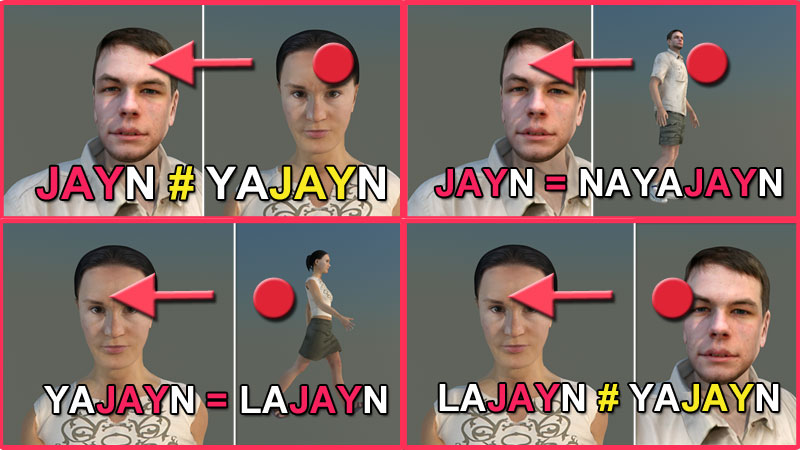
If the next identical AY-root doesn't evoke the same object, it is marked by YA ("a" as in "cat") inserted just before the root. The same applies to the OU-Modes.
JAYN... JAYN : An individual... The same individual (indefinite).
JAYN... YA_JAYN : An individual... Another individual.
JAYN... NAYA_JAYN : An individual... The very same individual (not another one, indefinite).
JAYN LA_JAYN : An individual... The same individual (definite).
LA_JAYN JAYN : The individual... The same individual (definite).
JEIN... SA_JEIN : Un individu... Un même individu (lui-même, vraiment).
JEIN... LA_JEIN : Un individu... Le même individu.
JEIN... DA_JEIN : Un individu... Ce même individu.
YA_JEIN... SA_JEIN : Un nouvel individu... Un même individu (le même).
YA_JAYN... LA_JAYN : An individual... The same individual.
YA_JAYN... DA_JAYN : An individual... That same individual.
VA_JAYN : Any individual (it does not matter which).
NAVA_JAYN : Not any individual - an individual that counts.
NA_JAYN : Not an individual - anything else.
***06***
If there is any doubt, ask by adding KA ("a" as in "cat") just before the AY-root or the OU-mode that could be something already evoked, or something never evoked before.
KAYA_JAYN : Is it another individual? - Is it someone else?
NAYA_JAYN : No, it is a same individual - No, it is not someone else.
YA_JAYN : Yes, it is another individual - Yes, it is someone else.
KALA_JAYN : Is the individual you are talking about?
NALA_JAYN : No, it is not the one I am talking about.
LA_JAYN : Yes, it is the one I am talking about.
KADA_JAYN : Is it that individual you are pointing at?
NADA_JAYN : No, it is not that individual I am pointing at.
DA_JAYN : Yes, it is that individual I am pointing at.
KAVA_JAYN : Are you talking about any individual, no matter which?
NAVA_JAYN : No, I am talking about one individual in particular.
VA_JAYN : Yes, any individual will do, I don't care.
***07***
An AY-root inside a SHOU mode does not evoke the same object that the same AY-root outside an SHOU mode. Please note that anything said in remai is supposed to be inside the OU-mode SHOU.
JAYJIN VO SAYGAN. JAY YO SHOU JEI RAON EN.
A man goes to the mountains. He said : « I see someone! »
The first and the second JAY evoke the same object (the man).
The third JAY is not supposed to evoke the same object because it is part of another conversation.
JAYJIN VO SEIGAN. JAY JAY SHOU BAOBAO EN.
A man goes to the mountains. He says to him-self : « Marvellous! ».
The third JAY is supposed to evoke the same object that the first and the second JAY.
***08***
Two roots or two modes before and after an O-verb evoke two different objects : the first is the origin of the action; the second the recipient. NO ("to be this way") is the exception: the origin can only be the same object as the recipient.
JAY YO JAY : Someone speaks to someone else.
JAY NO JAYWIN : The individual is a woman.
A final-N after an O-verb stops this.
JAY YON JAY or JAY YO ONJAY : Someone speaks to himself.
***
***09***
An EU-tie before an AY-root indicates that the evoked object is tied to the root before. JU before the root indicates that it evokes the same object that the root before.
JAY WUJAYWIN : The individual that is accompanied by a woman.
JAY JUJAYWIN : The individual that is a woman.
***
TO CHAPTER FOUR
***
***Fin de l'article***
***
DROITS
La totalité du Manuel Rapide de Rémaï 32 et ses illustrations visuelles ou sonores a été créé par David Sicé de 2007 à 2012. Celui-ci a placé ces contenus sous licence Creative Commons Attribution + Non Commerciale + Non Dérivative : Il est donc permis de reproduire ce qui suit dans un but non commercial, sans l'adapter et sous réserve de rappeler que l'auteur en est David Sicé. Il est interdit de reproduire, d'utiliser ou d'adapter ce qui suit pour en faire un usage commerciale sans autorisation écrite de David Sicé. Il est interdit d'adapter ou de modifier ce qui suit, même dans un but non commercial sans autorisation écrite de David Sicé.
***